

Beyond the Screen: Why Offline Play Matters
Preschoolers today are growing up in a world saturated with screens. Balancing digital engagement with plenty of offline play is more important than ever. Young children accustomed to instant gratification from tablets and televisions need the foundational skills developed through traditional play.
This isn’t about demonizing technology – screens have their place. But excessive screen time can hinder a child’s social-emotional growth, creativity, and physical development. Screen-free activities help children construct their own worlds, solve problems independently, and learn to interact with others. These experiences build resilience and a sense of self.
The American Academy of Pediatrics (AAP) recommends that for children ages 2 to 5, screen time should be limited to 1 hour per day of high-quality programming when parents are co-viewing. For children under 18 months, the AAP suggests avoiding screen time altogether, except for video-chatting. The emphasis is on intentional media use and prioritizing real-world experiences. Finding a healthy balance supports a child's overall well-being.
The goal is to provide children with opportunities to explore, imagine, and learn through hands-on experiences. Screen-free play is an essential ingredient for raising well-rounded, confident, and capable individuals. We need to cultivate these experiences in a world that often pulls us towards the digital realm.
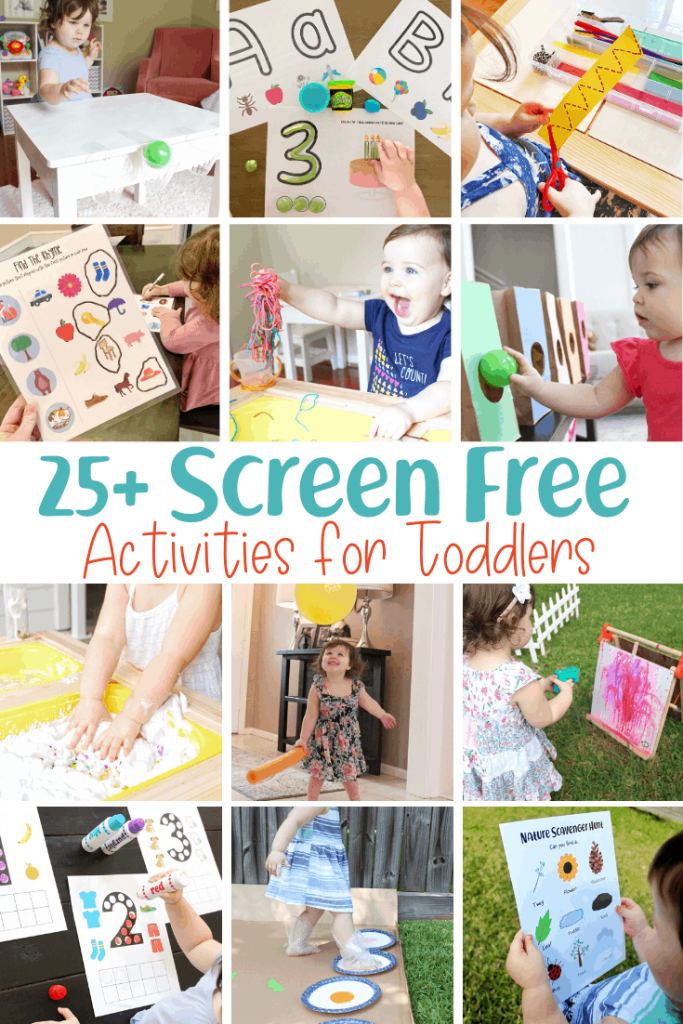
25 Screen-Free Activities for Little Learners
Here are 25 screen-free activities to spark imagination and learning in your preschooler. They are broken down into categories to help you find something that fits your child’s interests and your available time.
Creative Activities: These activities encourage self-expression and artistic exploration. 1. Playdough Creations: Provide playdough, cookie cutters, and rolling pins for hours of imaginative fun. This builds fine motor skills and encourages creativity. 2. Painting: Watercolors, finger paints, or even painting with sponges offer a sensory experience and allow children to experiment with color. 3. Collage Making: Gather scraps of paper, fabric, and other materials for a collage project. 4. Storytelling with Props: Use puppets, stuffed animals, or small toys to act out stories. 5. Shadow Puppets: A simple flashlight and your hands can create a world of shadow play.
Physical Activities: Getting bodies moving is crucial for development. 6. Building Forts: Blankets, pillows, and furniture can be transformed into a cozy fort. This encourages problem-solving and imaginative play. 7. Obstacle Course: Use pillows, cushions, and toys to create an indoor obstacle course. 8. Animal Walks: Encourage children to move like different animals—hop like a bunny, waddle like a duck. 9. Dancing to Music: Put on some music and let loose! This promotes coordination and self-expression. 10. Movement Scavenger Hunt: Hide objects around the room and give clues that involve movement (e.g., "hop to the red block").
Sensory Activities: These activities engage the senses and promote brain development. 11. Water Play: Fill a bin with water and add cups, containers, and toys. 12. Sensory Bins: Fill a bin with rice, beans, pasta, or other materials and hide small objects inside. 13. Cloud Dough: Combine flour and baby oil for a soft, moldable sensory experience. 14. Nature Walk: Explore the outdoors and collect leaves, sticks, and stones. 15. Mud Kitchen: Set up a designated mud kitchen area for messy, imaginative play.
Cognitive Activities: These activities promote problem-solving and early learning. 16. Puzzles: Start with simple puzzles and gradually increase the difficulty. 17. Sorting Activities: Sort objects by color, shape, or size. 18. Building with Blocks: Blocks encourage spatial reasoning and problem-solving. 19. Simple Board Games: Introduce age-appropriate board games with simple rules. 20. Scavenger Hunts: Create a scavenger hunt with clues that lead to a hidden treasure.
Role Play & Imagination: These provide opportunities for social and emotional growth. 21. Dress-Up: Provide a collection of dress-up clothes and accessories. 22. ‘Doctor's Office’ Role Play: Let children play doctor and nurse with stuffed animals or dolls. 23. Creating a Family Scrapbook: Gather photos and mementos to create a family scrapbook. 24. Learning Simple Sign Language: Introduce basic signs for common words and phrases. 25. Making Musical Instruments: Use recycled materials to create homemade instruments like shakers and drums.
Sensory Exploration: Engaging the Senses
Sensory play is more than just fun and games; it’s a component of preschool development. Engaging a child’s senses – touch, sight, sound, smell, and taste – stimulates brain development and helps them make sense of the world. It supports language skills as children learn to describe what they're experiencing and provides calming experiences that can help regulate emotions.
Creating sensory experiences doesn’t require expensive toys or elaborate setups. The simplest materials are often the most engaging. For example, a cloud dough bin is easy to make. Combine 8 cups of flour with 1 cup of baby oil. The result is a soft, moldable dough that’s perfect for scooping, pouring, and shaping. Always supervise closely, as with any sensory activity, to prevent ingestion.
Another popular option is a rainbow rice bin. Dyeing rice with food coloring is a straightforward process and creates a visually stimulating experience. A water bead sensory station is also a hit, though requires very close supervision due to the choking hazard. Use large, non-toxic water beads and ensure your child understands they are not to be eaten.
Safety Considerations: When planning sensory activities, always prioritize safety. Ensure materials are non-toxic and age-appropriate. Supervise children closely to prevent ingestion or choking hazards. Be mindful of allergies and sensitivities. Provide a designated space for sensory play that’s easy to clean.
Movement & Music: Getting Bodies Moving
Preschoolers are bundles of energy, and providing opportunities for physical activity is essential for their development. Movement supports gross motor skill development, coordination, and balance. It also helps children release energy, regulate their emotions, and build confidence.
Obstacle courses are a way to get kids moving. Use pillows, cushions, blankets, and toys to create a challenging and fun course. You can incorporate different movements like crawling, jumping, and climbing. Animal walks are another engaging activity. Encourage children to imitate different animals – hop like a bunny, waddle like a duck, slither like a snake.
Music is a tool for encouraging movement. Put on some upbeat music and let children dance freely. You can also play follow-the-leader, taking turns leading the group in different movements. A "movement scavenger hunt’ adds fun. Give clues that involve movement, such as ‘hop to the red block’ or ‘crawl under the table."
Incorporate music and movement into everyday routines. Sing songs while getting dressed, march around the room during cleanup time, or have a dance party while waiting for dinner. These small moments can make a difference in a child’s overall well-being.
Creative Expression: Art & Storytelling
Art and storytelling are for fostering imagination, self-expression, and language development. When children create art, they're exploring their emotions, experimenting with different materials, and developing their fine motor skills. When they tell stories, they’re practicing language, sequencing events, and building narrative skills.
Encourage children to experiment with different art materials. Provide watercolors, finger paints, crayons, markers, and brushes of various sizes. Let them paint on different surfaces – paper, cardboard, or even large sheets of butcher paper. Collage making is another option. Gather scraps of paper, fabric, and other materials and let children create their own unique artwork.
Storytelling can be enhanced with props. Use puppets, stuffed animals, or small toys to act out stories. Encourage children to create their own stories and characters. You can also start a story together and take turns adding sentences or paragraphs. Making puppets is a creative activity and can lead to hours of imaginative play.
The focus should be on the process of creating, rather than the final product. Encourage children to explore, experiment, and express themselves freely. Avoid criticizing their work or imposing your own ideas. The goal is to nurture their creativity and build their confidence.
Learning Through Play: Cognitive Skills
Play isn’t just fun; it’s a tool for cognitive development. Activities that challenge children to think critically, solve problems, and develop early math and literacy skills lay the foundation for future academic success. These skills are developed through engaging, hands-on experiences.
Puzzles promote problem-solving skills. Start with simple puzzles with a few large pieces and gradually increase the difficulty as your child progresses. Sorting activities help children develop categorization skills. Provide a collection of objects and ask them to sort them by color, shape, or size. Building with blocks encourages spatial reasoning and problem-solving.
Simple board games introduce children to concepts like taking turns, following rules, and counting. Reading books together is a way to foster language development and a love of reading. Creating scavenger hunts encourages problem-solving and observational skills. Hide objects around the room and provide clues that lead to the hidden treasure.
Adapt activities to suit your child's skill level. For younger children, focus on simple tasks and provide plenty of support. For older children, offer more challenging activities and encourage them to work independently. The key is to provide opportunities for growth and learning at their own pace.
Adapting Activities for Different Ages
Preschoolers develop at different rates, so adapt activities to meet their individual needs. A 2-year-old will approach an activity differently than a 4-year-old. Being flexible and adjusting the complexity of an activity ensures that all children are engaged and challenged.
For 2-year-olds, focus on simple activities with lots of repetition. Sensory bins should contain larger objects to minimize choking hazards, and supervision should be constant. Keep instructions short and simple, and provide plenty of assistance. For 3-year-olds, you can introduce more complex activities and encourage them to work more independently. They can handle slightly smaller objects in sensory bins and are starting to understand more complex rules.
4-year-olds are capable of more sophisticated play. They can participate in more complex games, follow multi-step instructions, and work collaboratively with others. Encourage them to take on leadership roles and challenge them with more difficult puzzles and problem-solving tasks.
Remember, it’s okay to modify activities to meet your child’s needs. Don’t be afraid to simplify an activity if it’s too challenging or to add more complexity if it’s too easy. The goal is to create a positive and engaging learning experience for your child.
Resources & Inspiration
Looking for more ideas? The internet is full of resources for screen-free activities. The Toddler Playbook () offers a wealth of inspiration for activities geared towards younger children. Preschool Playbook () provides a comprehensive collection of ideas for preschoolers, covering crafts, activities, songs, and more.
Don't hesitate to explore local libraries and community centers for story times, playgroups, and other screen-free events. Connecting with other parents can also provide valuable support and inspiration. Remember, fostering a love of learning through play is a journey, and there are plenty of resources available to help you along the way.
No comments yet. Be the first to share your thoughts!